Industry Overview
Adhesives are substances that create durable bonds between two or more different materials via physical or chemical reactions. Shoe‑making adhesives are specially formulated for footwear production, characterised by simple processing, high bonding strength and fast application speed.
Polyurethane adhesives refer to bonding materials whose molecular chains contain carbamate groups (-NHCOO‑) or isocyanate groups (-NCO). They fall into two main categories: polyisocyanates and polyurethanes. Containing ‑NCO and ‑NH‑COO‑ groups, polyisocyanate‑based adhesives deliver high chemical activity and polarity. They form reliable adhesion to substrates with active‑hydrogen sites, including porous materials such as foam, plastic, wood, leather, fabric, paper and ceramic, as well as smooth‑surface materials like metal, glass, rubber and plastics.
Within the broader adhesive landscape, polyurethane adhesives maintain stable market standing. After curing, they retain stable physical‑chemical properties even under low‑temperature and ultra‑low‑temperature operating conditions, widely adopted for shoemaking, packaging, automotive manufacturing and magnetic recording material production. Other major adhesive types include synthetic‑rubber‑based adhesives, epoxy adhesives, acrylic adhesives and silicone adhesives, each serving distinct industrial scenarios.
Industry Policy & Development Background
Multiple national authorities have rolled out policies guiding sustainable development for the chemical and adhesive industry. Documents cover energy‑saving & emission reduction, high‑quality advancement of petrochemical sector and green‑manufacturing system construction. Rising global environmental awareness has pushed sustainability to the core agenda across manufacturing industries.
Relevant regulatory catalogues classify low‑VOC adhesives as encouraged products for industrial upgrade; define polyurethane adhesives as flammable hazardous chemicals; open investment support for adhesive manufacturing; and set clear compliance requirements for hazardous‑chemical project construction. These policy frameworks shape product R‑D, production and market access for polyurethane adhesive manufacturers.
Polyurethane Adhesive Industry Supply Chain
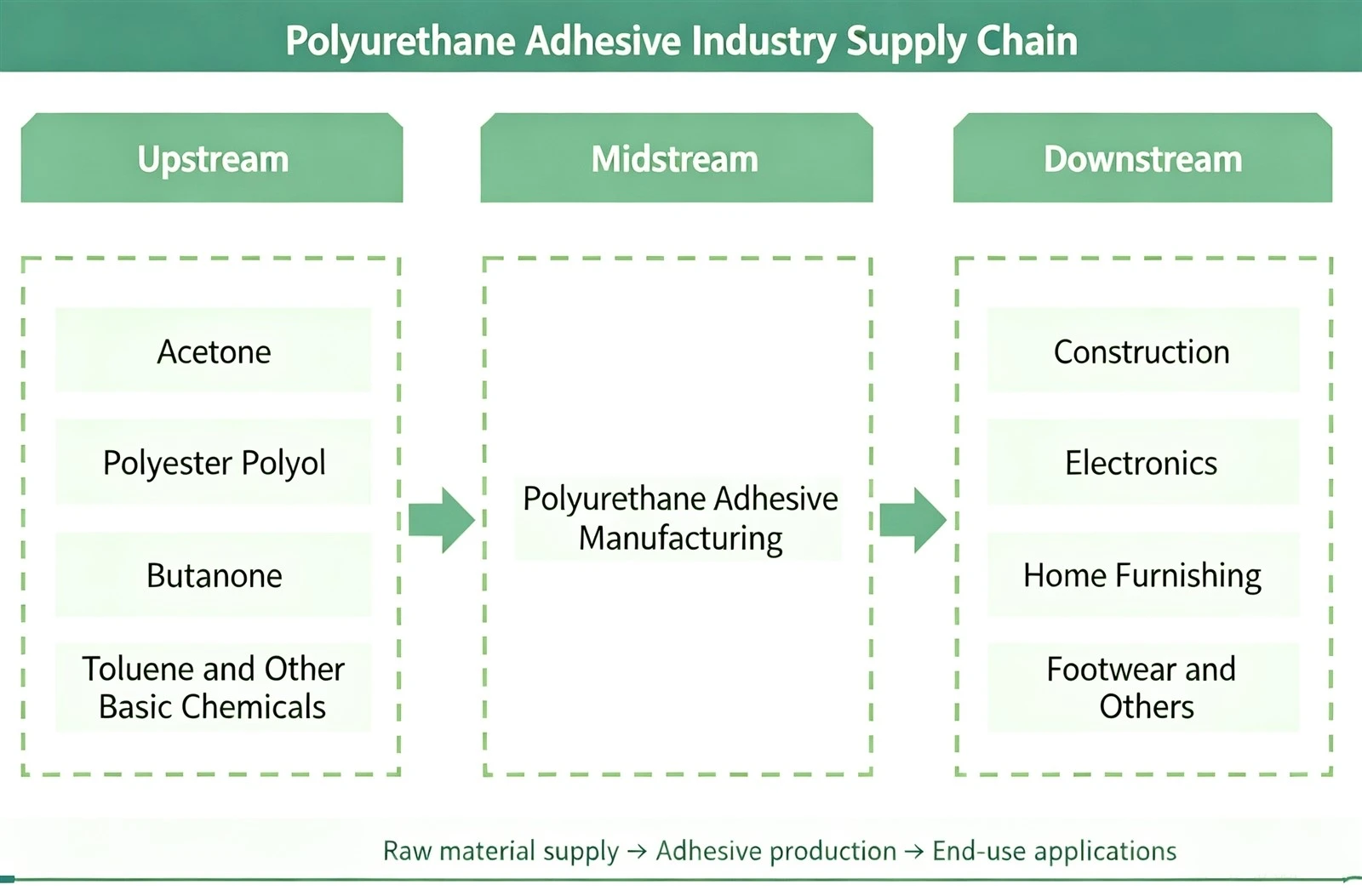
The upstream segment consists of basic chemical raw‑material manufacturers. Key feedstocks include acetone, butanone, polyester polyols, dimethyl carbonate, toluene and other petrochemical derivatives. Raw‑material costs fluctuate closely following global crude‑oil price movements.
Mid‑stream covers the manufacturing and formulation of finished polyurethane adhesive products.
Downstream applications span a wide range of end‑use industries: packaging, building & construction, electronics, automotive, home furnishing and footwear manufacturing. Diverse downstream demands further drive product iteration and technical optimisation in the mid‑stream adhesive sector.
Domestic Industry Current Situation
Possessing excellent shear‑resistance, impact‑resistance, rubber‑like elasticity and internal cohesion, polyurethane adhesives deliver flexible yet tough adhesive films, alongside good heat and chemical resistance. Their superior performance at low and ultra‑low temperatures places them among high‑grade adhesive offerings.
China's polyurethane‑adhesive output keeps growing year‑on‑year. The production volume reached 1.043 million tons in 2025, with a compound annual growth rate of approximately 5.65% from 2017 to 2025.
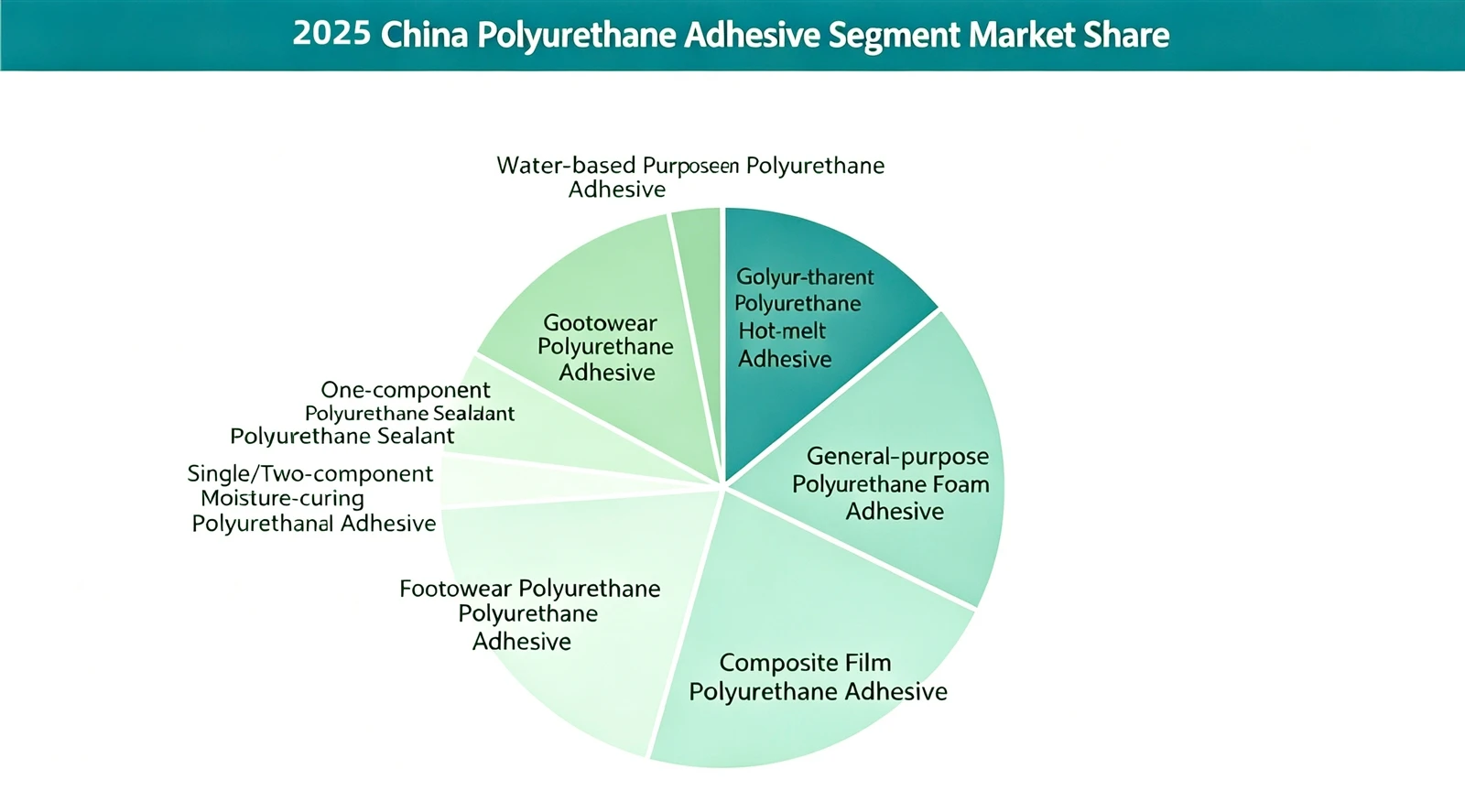
The market contains multiple product lines: general‑purpose polyurethane adhesives, footwear‑grade polyurethane adhesives, composite‑film polyurethane adhesives, one‑component polyurethane foam sealants, single‑/two‑component moisture‑curing structural adhesives, polyurethane sealants, polyurethane hot‑melt adhesives and water‑borne polyurethane adhesives. Based on 2025 market data, composite‑film polyurethane adhesives account for 22% market share, one‑component foam sealants take 20%, shoe‑making polyurethane adhesives occupy 18%, and general‑purpose types represent 14% of the total market.
Future Development Trends of Polyurethane Adhesive Industry
- Increasingly strict environmental‑protection regulations Solvent‑borne oil‑based adhesives with high volatile‑organic‑compound content are gradually phased‑out due to odour, irritation and pollution risks. Regulatory requirements for VOC reduction push the whole sector toward green transformation. Low‑VOC solutions including water‑borne, hot‑melt, solvent‑free, radiation‑curing, modified and biodegradable adhesives gain growing market traction, progressively replacing traditional solvent‑based counterparts. Environmental compliance and sustainable development will remain core drivers for the whole industry.
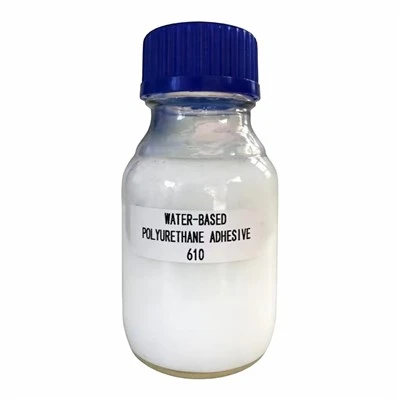
- Growing market demand for eco‑friendly adhesive products Countries worldwide are enforcing stricter legislation limiting organic‑solvent consumption. China's water‑borne polyurethane adhesive market is expanding at a rate exceeding the industry average. Ongoing technical innovation will unlock further application potential for water‑borne polyurethane solutions, supporting green upgrades for downstream manufacturing sectors.
- Rising market concentration Market and users raise requirements for product performance, quality and environmental‑friendly attributes. Intensified competition squeezes profit margins for low‑end products. Small‑scale manufacturers with outdated technology, heavy pollution and weak innovation capacity are being eliminated. Leading enterprises are expanding production capacity, boosting R‑D investment and improving automation levels. The industry moves toward large‑scale, centralised development, while advantages in production scale and complete supply chains become key competitive factors for adhesive producers.